
Real-world Results
See how we’ve made a difference by designing impactful digital products that improve business. We work with clients in a variety of industries and of different sizes, but with one goal in common: a digital differentiator.
Case Studies
About Cardoza Plumbing
Modernizing Construction Operations with a Custom Enterprise Platform
AVI partnered with Cardoza to develop a modern, centralized enterprise platform that replaced the aging desktop application with a secure, web-based solution designed around the company's unique workflows. Today, the platform serves as the operational backbone of Cardoza's business, streamlining project execution from initial bid through final invoice while continuing to evolve alongside the company's changing needs.

Coral Restoration Foundation
AI, Machine Learning, Coral Restoration Foundation, Environmental Conservation
Over multiple years, AVI partnered with CRF to build CeruleanAI, an advanced AI-driven solution that streamlined image processing and tracked restoration progress across tens of thousands of images and square meters of reef. From AI-powered coral health insights to a centralized knowledge hub and built-in onboarding and payment tools, the platform helps support CRF’s work, helping teams operate more efficiently while making it easier to share information and coordinate restoration efforts across regions.
Code Dx
Autonomous AppSec Project Management
AVI worked with Code Dx to produce a software platform to automate the AppSec process—accurately, quickly, and at scale. It had to interface with existing scanners to ingest test results and get rid of duplicate findings.
Planet Fitness
Updated Mobile App Experience
Planet Fitness didn’t have much of a digital presence beyond their website, and they wanted to modernize their business. Existing solutions weren’t cutting it, so they partnered with Applied Visions to develop a fully custom mobile app experience that drives engagement and adds top-line revenue.
Touchcode
Connected packaging technology
Applied Visions partnered with Touchcode to completely overhaul their main product, a patented, unique smart-ink technology for retail packaging. This collaboration resulted in the architecture and applications that have helped countless retailers connect with their customers digitally.
BloomNet
Leading floral and gift industry provider
BloomNet had a big problem: they have retail florists in their network, and managing local deliveries for that many separate businesses was extremely difficult. Applied Visions partnered with BloomNet to integrate a combination of custom and existing software into their main software, so they can manage everything in one place.
Additional Research
Application Security Technologies and Metrics (ASTAM)
The Application Security Technologies and Metrics (ASTAM) program is a U.S. Department of Homeland Security (DHS) Science and Technology Directorate funded project that seeks to improve the security of software through the development and enhancement of technologies that support all aspects of the secure software development lifecycle.
The technologies being developed under ASTAM automate techniques used to identify cyber security threats to software applications, improve insight into code testing coverage, make it easier to incorporate AppSec into the software development pipeline, and provide meaningful metrics to security analysts and cyber risk managers about the status, progress, and trends of application security.
The ASTAM program brings automation to the largely manual application security process, developing several technologies as independent capabilities.
Athena Test Network (ATN)

As part of an Intelligence Advanced Research Projects Activity (IARPA) effort, AVI teamed with the Johns Hopkins University Applied Physics Laboratory (APL) to assist in designing and building an agile ATN experimentation environment. ATN was built to host experimentation scenarios designed to evaluate technology systems under test (SUTs) while providing consistency and valid scientific method throughout the experimentation environment. Our team helped to design and develop the experimentation network command and control (C2) environment to support experimentation operations, designed and developed ATN C2 interfaces to SUT technologies and assisted in the design of measurement methods, scoring & metrics scorecards.
Branching Interactive Graphic Stories for Cyber Security Education (BIGSCE)
The Branching Interactive Graphic Stories for Cybersecurity Education (BIGSCE) project, sponsored by the National Science Foundation (NSF), enabled us to evaluate how to use branching, interactive web comics to teach middle school students about cyber security. Branching stories provide opportunities to explore cause and effect, and middle school students found the comic book style highly engaging. The project leveraged Comic-BEE, AVI’s cyber security education technology based on research sponsored by the Department of Homeland Security (DHS) Science and Technology Directorate, Cyber Security Division (DHS S&T/CSD).
BIGSCE informed the development of new approaches to teaching and learning cyber security: branching graphic stories can incorporate culturally relevant pedagogy, and therefore have the potential to reach a broader and more diverse body of students. The goal of BIGSCE was to explore how this innovative technology can enhance cyber security education, with the following aims:
- Attract a broad and diverse workforce to the field of cyber security, starting in middle school.
- Use expert-created comics to evaluate a learner’s knowledge, skill, and ability in the area of cyber security.
- Deepen students’ understanding of cyber security challenges and consequences using a comic creation activity. BIGSCE will also contribute new understanding of how to effectively use branching, graphic stories as a learning and assessment tool for middle school students.
AVI partnered with Stony Brook University, led by Dr. Lori Scarlatos, Associate Professor, Department of Technology & Society. The free workshops were held at the Town of North Hempstead’s “Yes We Can Community Center” in New Cassel, New York.
The BIGSCE workshops covered topic such as:
- Privacy and keeping safe on the Internet
- The nature of cyber crimes
- Cyber security professionals, and how they solve those crimes
- Heroes in cyber security and STEM (science, technology, engineering, mathematics)
- Fact and fiction in television and movies about cyber security
- How to prepare for a career in cyber security
See the video with some of our workshop participants!
“Branching Interactive Graphic Stories for Cybersecurity Education” (BIGSCE) was sponsored by the National Science Foundation, Award Number 1623131.
Camus: Mapping Cyber Assets to Missions and Users
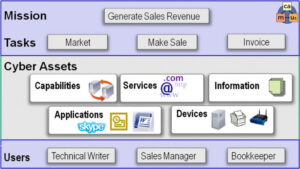
Camus (Cuh-moo) is a proof of concept that enables cyber impact assessment by modeling and automatically mapping cyber assets to the missions and users that depend on them.
Camus collects from various sources data that describe the organization and the activity between users and cyber assets, such as traffic captures and people directories, and fuses the data into a comprehensive model that reveals relationships between cyber assets and the users and missions that rely on them. By automatically mining existing data to create contextual information, Camus provides an up-to-date picture of what an organization really looks like, who uses what asset, and what they are using it for. This information improves risk assessments by identifying critical assets and single points of failure for critical processes, and enhances situational awareness by providing an improved context for the decision-making process. Additionally, with no manual maintenance to update dependencies, and no client software install required, Camus saves time and labor.
Camus was funded by the Office of the Secretary of Defense, and managed by the Air Force Research Laboratory through a two-year Phase II Small Business Innovative Research contract that commenced in May 2008.
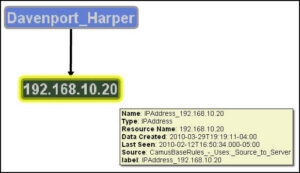
Mission-to-Cyber Mapping Ontology
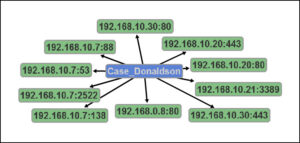
Underlying the Camus technology is a cyber asset-to-mission ontology, which was developed with a multidisciplinary group of leading subject matter experts and operational practitioners. The ontology uses Resources (entities) and Properties (relationships) to build a model of the domain. The Resources define specific concepts in the domain, while the Properties define the relationships between the Resources. We defined this ontology based on the concepts of User, Mission, Capability, and Asset.We developed a Foundation Ontology that defines the core Resources and Properties for Camus and an Extension Ontology that can extend the Foundation Ontology for a specific implementation.
Mission Impact Workshop
As part of the Camus project, Secure Decisions conducted a workshop on mapping cyber assets to missions and users. The workshop addressed how to map the relationships between cyber assets such as network devices and the users, missions, business processes and other entities that depend on those assets. The 30 participants included individuals with operational responsibility is to assure the availability of cyber assets for critical missions, researchers in areas related to the mapping of cyber assets to missions, and developers of technology that can be used in this mapping. The group exercises yielded insight into the information requirements for mapping cyber assets to missions and users, and the participant’s presentations summarized the state-of-the-art of this topic.
Code Dx

Code Dx is an award-winning application security tool that correlates weakness data from open source and commercial source code and dynamic analysis tools, putting them into the proper context for effective triage and mitigation. The software integrates the results of multiple software analysis tools into one coherent picture, offers a workflow that lets analysts visually analyze and prioritize results, explore them to uncover trends, and assign remediation tasks. Originally developed by Secure Decisions, the intellectual property of Code Dx was transferred to Code Dx, Inc. as part of a corporate spin-out.
Code Pulse

Code Pulse is a penetration testing support tool that provides real-time visual feedback into the code coverage of black box testing activities. Originally developed by Applied Visions Inc., Code Pulse is an official OWASP Project and is now maintained by Code Dx, Inc. after the intellectual property was transferred during a corporate spin-out.
Code Ray
Hybrid Analysis Mapping
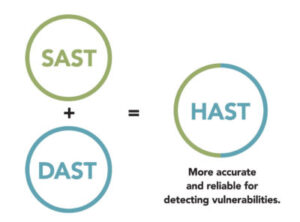
Two methods for analyzing software security risks are dynamic application security testing (DAST), an outside-in perspective, and static application security testing (SAST), an inside-out perspective. Both have shortfalls. DAST findings do not give insight into the root cause, making remediation time-consuming. SAST tools give you full breadth, but warn of weaknesses that are not exploitable.
Correlating the results of SAST and DAST can overcome these individual challenges. AVI engaged in a DHS-funded Phase II SBIR program entitled Code Ray: Software Assurance Risk Management Framework for Hybrid Analysis Mapping, to produce a hybrid analysis method that can be incorporated into Code Dx and into the DHS SWAMP.
The end result of this R&D program (1) improved speed, accuracy and confidence in detection of vulnerabilities by cross-mapping and normalizing the output of hybrid techniques – dynamic analysis, dynamic tracing, static analysis, and static contextual analysis; (2) enhanced prioritization and mitigation of vulnerabilities by providing both the run-time context for those vulnerabilities and their mapping to security standards; and (3) improved the rapid comprehension and assessment of risks associated with vulnerabilities by delivering results in a simplified risk-management framework.
Comic-BEE

Comic-BEE provides an integrated, guided process for educators and subject matter experts to plan a lesson, write a branching script that is closely aligned with their instructional goals, storyboard the visual layout of their comic, and format the comic with final artwork prior to online delivery and presentation.
CWE-Vis
Common Weakness Enumeration Visualization
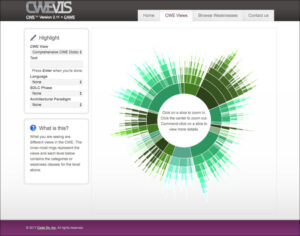
CWE-Vis is a resource made available to the software assurance community to explore and learn about weaknesses in software. It provides visualizations and interactions with MITRE’s Common Weakness Enumeration (CWE), an international standard created to define a dictionary of software weaknesses. The CWE greatly facilitates the discussion and collaboration in efforts revolving around the always-present quest to improve software systems. CWE-Vis helps users familiarize themselves with the CWE through visual means. High-level CWE structures and detailed relationship graphs are displayed visually helping users gain a better and quicker understanding of the CWE. Powerful filtering and searching is made available to allow users to focus in on the details of how weaknesses can be manifested in source code and ways to avoid and fix them.
CyberMiSTS
The Curriculum to Broaden Participation in Cybersecurity for Middle School Teachers and Students (CyberMiSTS) project builds on BIGSCE, our prior NSF-funded research into cybersecurity education. In CyberMiSTS, we are developing and disseminating a curriculum and resources for giving middle schools educators the knowledge, skills, and tools the need to teach cybersecurity.
During the CyberMiSTS workshop, educators will gain insights from cybersecurity researchers and educators, and learn to use a variety of interactive instructional approaches for teaching cybersecurity, including Comic-BEE, Applied Visions Inc. web application for creating branching web comics aligned with a lesson plan. With basic curriculum, resources, and guidance from the CyberMiSTS team, each educator will create a customized lesson plan for cybersecurity and course materials targeted at their own students.
Educators are expected to use their lesson plan and course materials in their own classrooms to teach their students about cybersecurity, and share aggregate and anonymized classroom data with the CyberMiSTS team.
CyberMiSTS has the following research aims:
- Integrate recent research-based understanding of cybersecurity into a curriculum that is accessible to teachers and their middle school students.
- Encourage participation of a broad and diverse set of students in the field of cybersecurity by showing them how human relations play an important role in cybersecurity.
- Identify what educators need to successfully teach cybersecurity in a middle school classroom and, based on this, develop guidelines and resources for disseminating this teacher instruction widely.
CyberMiSTS is funded by an award from the National Science Foundation, under the Secure & Trustworthy Cyberspace: Education (SaTC: EDU) Program, Award Abstract #1821757.
Applied Visions Inc. partnered with a team from Stony Brook University led by Dr. Lori Scarlatos, Associate Professor of Educational Technology, Department of Technology & Society, College of Engineering & Applied Sciences.
The Flying Squirrel Wireless Assessment Tool Suite

To enhance the security posture of DoD networks, Flying Squirrel provides real-time wireless discovery, integrated visualization and mapping, and post-hoc analysis capabilities. These capabilities are provided in the Flying Squirrel Wireless Assessment Tool Suite via the Flying Squirrel, MeerCAT-FS, Caribou and Ubertooth One components. For a complete description of the Flying Squirrel Suite of technologies, please visit the Naval Research Laboratory (NRL) Center for High Assurance Computing Systems (CHACS).
InterTEC Cyber Event (ICE) Cyber Experimentation Environment (CEE)
As part of an Air Force Research Lab research project, AVI worked to identify specific types of mission data needed to support the AFRL Cyber Experimentation Environment, determined and helped to implement the practical mechanisms for harvesting such data from a military exercise (the InterTEC Cyber Event), and developed mission-relevant datasets, based on data harvested from the ICE Exercise, to support a mission-centric testing environment for the CEE.
MeerCAT®-Pro
MeerCAT®-Pro is an award-winning visualization tool specifically developed to help decision makers locate wireless assets and networks, and assess the risk they pose to the organization. What distinguishes MeerCAT®-Pro are its advanced visual analytics specifically designed to support and expedite wireless security risk assessment. MeerCAT®-Pro presents interactive geospatial, topological, and spatiotemporal 3D views to quickly locate potential security issues, and to efficiently identify relevant vulnerabilities, threats, and remediation.
Mission Impact/ Mission Assurance
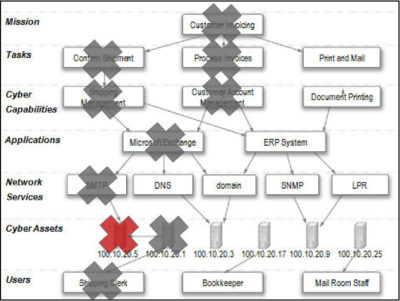
Systems administrators in large data centers often do not know the mission of the machines they manage; their strategy is, “Let’s pull the plug and see who calls.”
The problem is similar for computer security analysts – they do not know the cyber capabilities, mission, or users that depend on a machine that is attacked.
To assess the impact of a compromised or degraded cyber asset, analysts need to know:
-
- Who relies on an attacked asset for their job?
- What social network will be disrupted if an asset is compromised?
- What organizational mission is impacted by the loss of an asset?
- What other assets or cyber capabilities depend on an attacked asset?
- Where is the attacked asset located in the physical or logical network?
This lack of contextual information makes it impossible to effectively prioritize cyber events or assess the impact of attacks. Because organizations do not have accurate mappings between mission tasks and the network assets on which they depend, decision makers cannot accurately assess mission readiness of their network assets or interpret operational impact of network failures or cyber attacks. Security analysts cannot report operational impact of cyber incidents or defensive countermeasures. Managers are unable to accurately assess mission or business risks associated with cyber incidents, or identify cascading operational effects from the degradation or loss of cyber assets.
A current and accurately map of the dependencies between mission tasks, information needed to perform those tasks, and the cyber assets that provide and communicate that information.
National Cyber Range
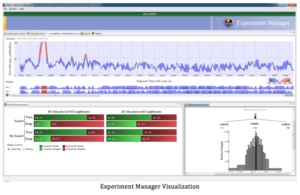
The Defense Advanced Research Projects Agency (DARPA) created a National Cyber Range (NCR) to protect and defend the nation’s critical information systems. The NCR revolutionized the state of the art for large-scale cyber testing and provided fully automated range management and test management suites to test and validate leap-ahead cyber research technologies and systems.
NetDemon

Goal Directed Task Analysis
The purpose of the NetDemon project was to identify the information real decision makers actually need, and how they use it. The goal was to identify that information in order to evaluate the environment in which these decision makers operate to determine how well the current technology meets their needs. Future designs can then be created that take those needs into account from the beginning, rather than add in critical features and integration later. To accomplish this, the NetDemon project documented specific information that was required for the operators to do their jobs, and how they used that information to address particular issues or inform decisions.
The first part of the NetDemon project was to determine the current decision model used by the client, and determine if the existing data sources and capabilities were adequate. In the second part of the project, we developed an idealized, future decision model that helped the client reach Information Dominance goals, and described the data necessary to support it. Once the model was defined, we identified technology insertion opportunities that provided new data sources and technologies to support the decision process, and to automate part of it.
Scalable Network Monitoring
DARPA’s Scalable Network Monitoring (SNM) program focused on the development and testing of gateway malicious activity detection devices. AVI teamed with Johns Hopkins University Applied Physics Lab (JHU/APL) to design, develop, and operate a cyber test environment that provides the capability to generate a sufficient volume of both benign and malicious activity to maintain full-line speed (from 1 Gbps to 100 Gbps) at the network gateway.
The Defense Advanced Research Projects Agency (DARPA) has created a Cyber Defense Program, responsible for developing the core computing and networking technologies required to protect DoD’s information, information infrastructure, and mission-critical information systems.
The Cyber Defense Program is developing network traffic monitoring techniques with performance and scalability orders of magnitude better than conventional approaches.
The focus of DARPA’s Scalable Network Monitoring (SNM) program is the development and testing of gateway malicious activity detection devices. Secure Decisions has teamed with Johns Hopkins University Applied Physics Lab (JHU/APL) to design, develop, and operate a cyber test environment, that provides the capability to generate a sufficient volume of both benign and malicious activity to maintain full-line speed (from 1 Gbps to 100 Gbps) at the network gateway.
Network engineers and analysts built a test network environment simulating a secure DoD network gateway and also designed test procedures, program metrics, and a corpus of malicious activity for use within the test environment. Through execution of a series of test scenarios, scoring of those results, and analysis of the performance of the systems under test, the SNM program will provide innovative network defense capabilities for the nation.
Applied Visions Inc. has built an SNM Status Board System for monitoring test execution. This system provides the ability to monitor the test network and display the performance of systems under test. The Status Board console is a Graphical User Interface consisting of six different information monitoring and management panels:
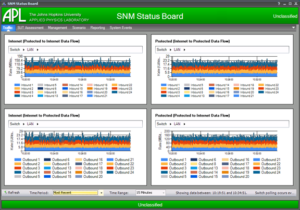
Traffic Panel
- Shows the quantity of throughput flowing through both the high bandwidth switches in both directions, for a total of four charts.
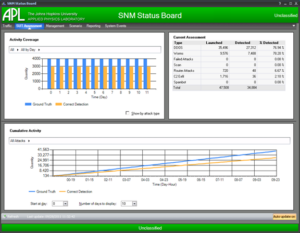
SUT Assessment Panel
- Displays the latest test results. It consists of three different regions: Activity Coverage, Cumulative Activity, and Current Assessment. The Activity Coverage and Cumulative Activity areas are both interactive charts, providing the user the ability to drill down or aggregate data of particular interest
Other panels include:
Management Panel
-
- Provides the ability to monitor switch status, manage switch state, configure switch monitoring polling intervals, and manage and refresh data.
Scenario Panel
-
- Allows the user the ability to add, modify, and delete scenarios related to a test event.
Reporting Panel
-
- Generates reports from test event data that support traffic measurements and SUT assessments.
Systems Event Panel
-
- Displays information related to the internal operation of the Status Board system.
ShortCut
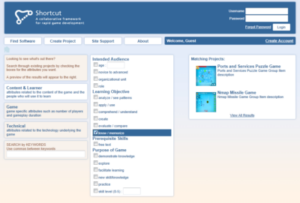
Creating interactive visualizations and educational games for skill acquisition is hard, requiring subject matter expertise and interactive design skills. Instructional goals and specific subject matter details must be integrated with other information to develop interactive scenarios. To provide a more efficient turnaround of training games or visualizations, we are developing ShortCut, a web-based collaborative framework for rapid development of serious games. ShortCut’s goal is to facilitate knowledge exchange between subject matter experts and game designers, thereby streamlining the creation of serious games. Using an interactive, web-based knowledge elicitation, ShortCut allows the instructor or subject matter expert to describe in detail the subject matter, and it also captures additional information needed by interaction and game designers, such as learning objectives and descriptions of real-world situations using the skill or knowledge.
SimBLEND: A Simulation-Based Learning Environment for Network Defense
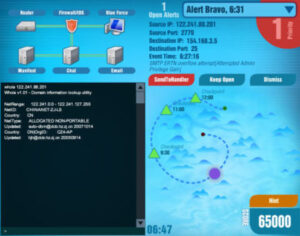
The result of a research program funded by the Air Force Research Laboratory Human Effectiveness Directorate, Warfighter Readiness Research Division (AFRL/HEA) to develop new and exciting concepts for training the next generation of cyber warriors, SimBLEND facilitates blending the delivery of computer based training (CBT) materials with interactive visualizations and serious games to create a web-based environment where learning is fun and skills can be practiced immediately. To demonstrate SimBLEND, we created browser-based, CND-themed casual games that focused on low-level cyber security concepts and tools. These games are simple to use and can be delivered as stand-alone games or integrated into a Learning Management System or other training environment.
SimBLEND was sponsored by Air Force Research Laboratory Contract number: FA8650-08-C6858.
Software Assurance Marketplace (SWAMP)
AVI has developed several professional partnerships and teamed with leaders in the Software Assurance community.
The SWAMP is a forward-looking effort to improve the state of secure software development, particularly for open source projects. Developed by Morgridge and funded by DHS it was an effort that has offered its initial capability since early 2014. It is no longer operational.
VIAssist™
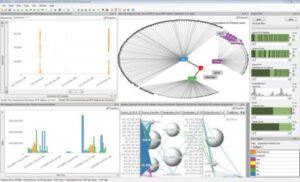
Network Defense Visualization
VIAssist is a visual analysis platform to help network security analysts protect their networks. It was designed after a comprehensive cognitive task analysis of network defenders. It provides visual tools for the evaluation of network flow and security data. VIAssist presents multiple, coordinated views – highlighted or filtered data in one view is reflected in all other views – to provide different visual perspectives of the data. These views transform network data into a collection of interactive visualizations that make it easier to analyze data, to see patterns and trends, and to identify risks and actionable information.
WhyViz – Transforming Cyber Data into Human-Centered Visualizations

The goal of WhyViz was to conduct a study of the effectiveness of visualizations on cyber operator performance during the early stages of incident handling, which require defense analysts to review an endless alert queue of cyber event data to identify, record, and report suspicious behavior or cyber events of interest. Most cyber security visualizations are currently used for historical analyses, however, as part of the WhyViz project, Secure Decisions developed visualizations to support the real-time, in situ processing as it is actually being performed by cyber operators to facilitate event detection and preliminary event analysis.
In Phase I of this Small Business Innovation Research (SBIR), we applied knowledge elicitation (KE) methods to define specific examples of cognitive work that occur in the early stages of incident handling that have the potential for being enhanced (faster, more accurate, more complete) through the use of visualizations by the cyber operator. This cognitive work took the form of the operator seeking to answer specific analytic questions using the available data, in a severely time-constrained work environment. A KE with domain practitioners revealed that cyber operators regularly ask fundamental analytical questions that cut across specific tasks and roles. Our research identified the type of information operators need to answer these questions, the visualization concepts that represent that information in a visual form that can be rapidly comprehended and acted on, and methods to transform raw cyber sensor data into a form that can be used to populate the visualizations. In Phase II of the project (in progress) we will conduct an experiment to objectively evaluate the effects of these visualizations on operator performance.
In Phase II of the project, we conducted an experiment to objectively evaluate the effects of these visualizations on cyber defense analyst performance.
Contract No: FA8650-16-C-6711
DISTRIBUTION STATEMENT A. Approved for public release: distribution is unlimited. 88ABW Cleared 02/08/2017; 88ABW-2017-0518.
WildCAT™ Wireless Threat Visual Analytics
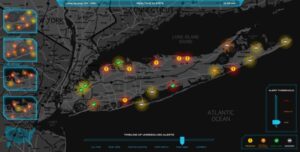
Wireless Threat Visual Analytics
Critical infrastructures can be vulnerable to cyber attacks through 802.11 wireless networks. WildCAT is a prototype system that enables integration of physical and cyber security resources in order to detect and immediately respond to wireless threats. It is designed to use physical security vehicles as a platform to collect wireless activity and send the data via a cellular network to an analysis center.